Friday, 17 February 2012

COMPROMISE, ART AND BREACH OF THE PEACE

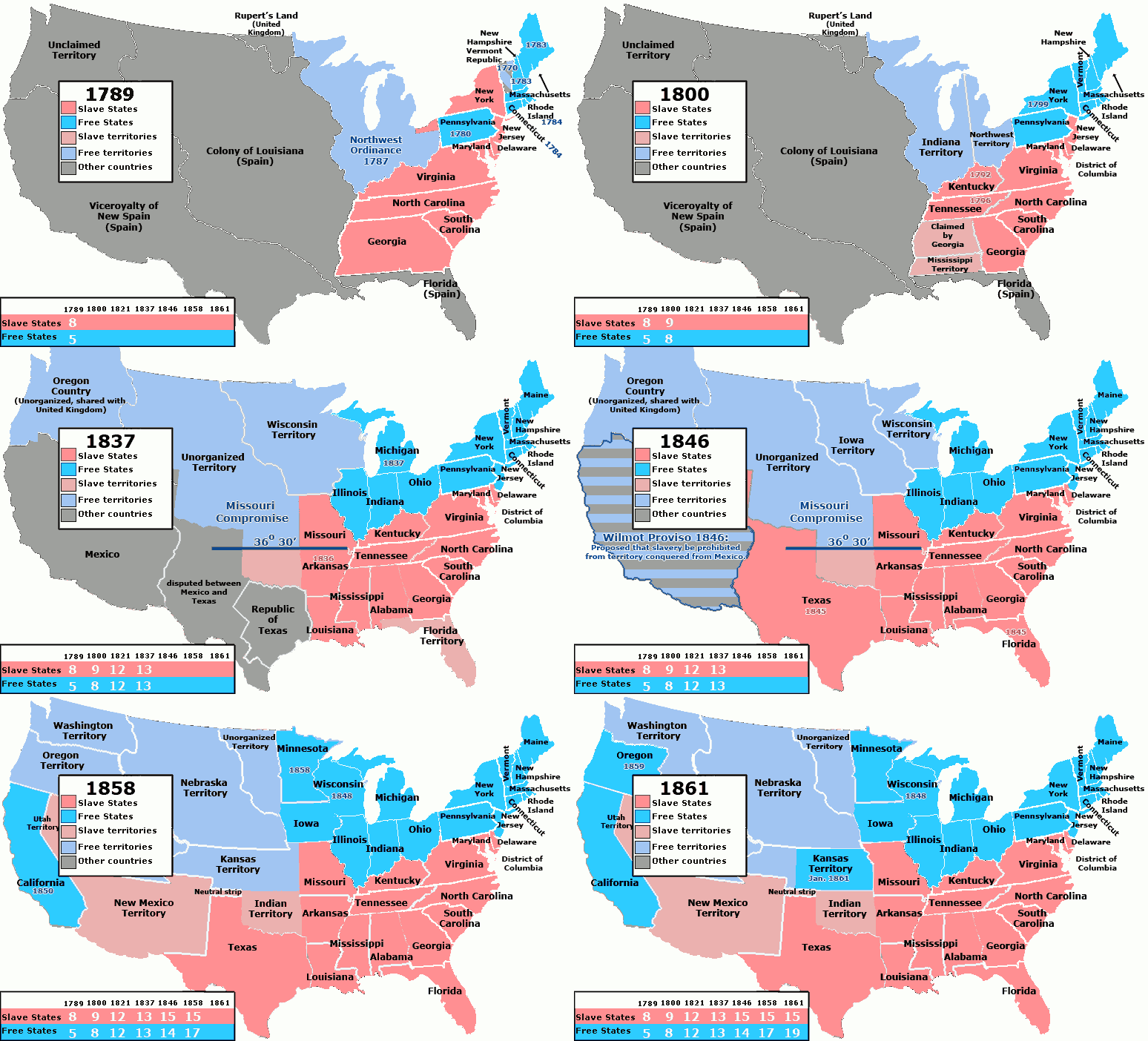
On the 17th February 1819 the United States House of Representatives passed the Missouri Compromise for the first time. It is here that the seeds of the American civil war were firmly planted.
The Missouri Compromise was an agreement passed in 1820 between the pro-slavery and anti-slavery factions in the United States Congress, involving primarily the regulation of slavery in the western territories. It prohibited slavery in the former Louisiana Territory north of the parallel 36°30′ north except within the boundaries of the proposed state of Missouri. Prior to the agreement, the House of Representatives had refused to accept this compromise, and a conference committee was appointed.
A bill to enable the people of the Missouri Territory to draft a constitution and form a government preliminary to admission into the Union came before the House of Representatives in Committee of the Whole, on 13th February, 1819. An amendment offered by James Tallmadge of New York (which was named the Tallmadge Amendment), which provided that the further introduction of slaves into Missouri should be forbidden, and that all children of slave parents born in the state after its admission should be free at the age of 25, was adopted by the committee and incorporated in the bill as finally passed on 17th February, 1819, by the house. The United States Senate refused to concur in the amendment, and the whole measure was lost.
In a 21st April letter to John Holmes, Thomas Jefferson wrote that the division of the country created by the Compromise would eventually lead to the destruction of the Union:
“...but this momentous question, like a fire bell in the night, awakened and filled me with terror. I considered it at once as the knell of the Union. it is hushed indeed for the moment. but this is a reprieve only, not a final sentence. a geographical line, coinciding with a marked principle, moral and political, once conceived and held up to the angry passions of men, will never be obliterated; and every new irritation will mark it deeper and deeper”
For an animation showing the free/slave status of U.S. states and territories, 1789–1861, including the Missouri Compromise go to:

One year ago I mentioned the opening on the 17th February of the Armory Show in 1913 in New York. It might be worth a look:
 http://fbuffnstuff.blogspot.com/2011/02/arms-armories-and-art.html

Here is a little item of flying history related to the Nixon White House in the middle of the Watergate scandal.

At 2 A.M. on 17th February, 1974, Robert K. Preston, a United States Army private first class, stole a United States Army UH-1 Iroquois helicopter from Fort Meade, Maryland, flew it to Washington, D.C., and hovered for six minutes over the White House before descending on the south lawn, about 100 yards from the West Wing.  There was no initial attempt from the Executive Protective Service to shoot the helicopter down, and he later took off and was chased by two Maryland State Police helicopters. Preston forced one of the police helicopters down through his manoeuvring of the helicopter, and then returned to the White House. This time, as he hovered above the south grounds, the Executive Protective Service fired at him with shotguns and submachine guns. Preston was injured slightly, and landed his helicopter.
 UH-1 Iroquois helicopter
In a plea bargain, he pled guilty to "wrongful appropriation and breach of the peace," and was sentenced to 1 year in prison and fined $2,400. This amounted to a six-month sentence, since he had already been in prison for six months at the time.
Preston was a 20-year-old private first class in the U.S. Army, stationed in Panama City, Florida. Although he was training to become a helicopter pilot, he abandoned the training due to "deficiency in the instrument phase". Preston had enrolled in the JROTC program at Rutherford High School in Panama City, Florida and had long-time aspirations to a military career. After being taken into custody Preston indicated he was upset over not being allowed to continue training to be a helicopter pilot, and staged the incident to show his skill as a pilot.

At the time of the incident, President Richard Nixon was travelling in Florida. 

Thursday, 16 February 2012

BBC - CBBS - UNFCCC

The 16th of February throws up three items in connection with some degree of social engineering.
The Toddlers’' Truce was a piece of early British television scheduling policy that required transmissions to terminate for an hour each weekday between 6pm and 7pm. This was from the end of Children's TV to the start of the evening schedule, so that young children could be put to bed.
The ITA had encouraged the ITV companies to seek abolition of the Truce. Action was taken finally in July 1956, probably the result of a lack of effective cooperation between the companies rather than political objection. The Postmaster General, Charles Hill, had disliked the policy as an example of the BBC's paternalism toward its audience:
This restriction seemed to me absurd and I said so. It was the responsibility of parents, not the state, to put their children to bed at the right time... I invited the BBC and the ITA to agree to its abolition[...]
The BBC could not, however, be persuaded to accept the abolition or even to a compromise of reducing the period to 30 minutes. Hill tired of the disagreement and asked Parliament for the abolition which was agreed on 31 October 1956. However, the BBC and ITA could not even agree a date for the abolition to take place. Hill decided on Saturday, 16th  February 1957.
The BBC filled the hour with a music programme, Six-Five Special, from the first Saturday and with the Tonight news magazine from Monday to Friday. The BBC however continued to close from 6.15-7.00pm on Sundays, the time of evening church services, until Songs of Praise was launched on 1 October 1961. Until 1992 this time on Sundays was used for religious programmes on BBC1 and ITV. The 6-7pm slot has since then been devoted to news, especially regional news, in the weekday schedules of both BBC1 and ITV, though Crossroads was also shown in this period in most ITV regions.
The first public dial-up Bulletin Board System was developed by Ward Christensen. Christensen, born in West Bend, Wisconsin, U.S., is the founder of the CBBS bulletin board, the first bulletin board system (BBS) ever brought online. Christensen, along with partner Randy Seuss, started development during a blizzard in Chicago, Illinois, and officially established CBBS four weeks later, on the 16th February, 1978. According to an early interview, while he was snowed in during the Great Blizzard of 1978 in Chicago, Christensen along with fellow hobbyist Randy Suess, began preliminary work on the Computerised Bulletin Board System, or CBBS. CBBS, which kept a count of callers, reportedly connected 253,301 callers before it was finally retired.

Christensen
The Kyoto Protocol is a protocol to the United Nations Framework Convention on Climate Change (UNFCCC or FCCC), aimed at fighting global warming. The UNFCCC is an international environmental treaty with the goal of achieving the "stabilisation of greenhouse gas concentrations in the atmosphere at a level that would prevent dangerous anthropogenic interference with the climate system.”
The Protocol was initially adopted on 11 December 1997 in Kyoto, Japan, and entered into force on 16th February 2005. As of September 2011, 191 states have signed and ratified the protocol. The only remaining signatory not to have ratified the protocol is the United States. Other United Nations member states which did not ratify the protocol are Afghanistan, Andorra and South Sudan. In December 2011, Canada denounced the Protocol.

Participation in the Kyoto Protocol, as of December 2011,
Brown = Countries that have signed and ratified the treaty
              (Annex I & II countries in dark brown)
Blue = No intention to ratify at this stage.
Dark blue = Canada, which withdrew from the Protocol in December 2011.

Grey = no position taken or position unknown  
Here's a wee bit of Toddler Truce time filler history:

Monday, 13 February 2012

LET'S FACE THE MUSIC

The 13th February is a musical day and some outstanding performance writing.
Herbert
The American Society of Composers, Authors and Publishers, ASCAP, was founded by composer Victor Herbert in New York City, New York, on 13th February, 1914, to protect the copyrighted musical compositions of its members, who were mostly writers and publishers associated with New York City's Tin Pan Alley. ASCAP's earliest members included the era's most active songwriters — Irving Berlin, Jerome Kern, Otto Harbach, John Phillip Sousa and James Weldon Johnson. Subsequently, many other prominent songwriters became members. As of July 2009, ASCAP membership included over 360,000 songwriters, composers and music publishers.
Berlin


Irving Berlin – whose songbook is probably unrivaled, including White Christmas, Alexander’s Ragtime Band, God Bless America, Blue skies, Cheek to Cheek, Heat Wave, Happy Holiday, Easter Parade, I’ve Got My Love to Keep Me Warm, Let’s Face the Music and Dance, Puttin’ on the Ritz and 800 plus others
Kern


Jerome Kern who wrote to music to a number of great songs including Smoke Gets in Your Eyes with lyrics by Otto Harbach, The Way You Look Tonight with lyrics by Dorothy Fields and The Last Time I Saw Paris with lyrics by Oscar Hammerstein.

Harbach


Otto Harbach also wrote the lyrics to Cuddle up a Little Closer, Lovey Mine with music by Karl Hoschna. He collaborated often with Kern and Oscar Hammerstein II.
Souza


John Phillip Souza was the marching band king with The Liberty Bell march, known as the theme for Monty Python.


Johnson


James Weldon Johnson who wrote Lift Every Voice and Sing was an American author, politician, diplomat, critic, journalist, poet, anthologist, educator, lawyer, songwriter, and early civil rights activist. Johnson is remembered best for his leadership within the NAACP, as well as for his writing, which includes novels, poems, and collections of folklore. He was also one of the first African-American professors at New York University. Later in life he was a professor of creative literature and writing at Fisk University. 


Sunday, 12 February 2012

ANARCHIST WITH A SENSE OF HISTORY

One hundred and eighteen years ago, on the 12th February 1894, a young French anarchist by the name of Émile Henry (b.1872), detonated a bomb at the Café Terminus of Paris’s Gare Saint-Lazare. One person was killed and twenty wounded.  He was eventually executed by guillotine on the 21st May 1894 age 21. His last words allegedly reported were "Courage camarades! Vive l'anarchie!" He also made a rather lengthy address to the jury to support his actions. Here are some excerpts. In his address he makes various remarks concerning other incidents which have occurred in other countries showing an overall grasp of the history of the anarchist movement of the late nineteenth century, and in particular the atrocities against the Paris Commune of the 1871, before he was even born.
Émile Henry
I became an anarchist only recently. It was no longer ago than around mid-1891 that I threw myself into the revolutionary movement. Previously, I had lived in circles wholly permeated with the established morality. I had been accustomed to respecting and even cherishing the principles of the nation, family, authority and property.
But those educating the present generation all too often forget one thing – that life, indiscreet with its struggles and setbacks, its injustices and iniquities, sees to it that the scales are removed from the eyes of the ignorant and that they are opened to reality. Which was the case with me, as it is with everyone. I had been told that this life was easy and largely open to intelligent, vagarious people, and experience showed me that only cynics and lackeys can get a good seat at the banquet.
I had been told that society’s institutions were founded on justice and equality, and all around me I could see nothing but lies and treachery. Everyday I was disabused further. Everywhere I went, I witnessed the same pain in some, the same delights in others. It did not take me long to realize that the same great words that I had been raised to venerate: honour, devotion, duty were merely a mask hiding the most shameful turpitude.
The factory-owner amassing a huge fortune on the back of the labour of his workers who lacked everything was an upright gentleman. The deputy, the minister whose hands were forever outstretched for bribes were committed to the public good. The officer testing his new model rifle on seven-year-old children had done his duty well, and in open parliament the premier offered him his congratulation. Everything I could see turned my stomach and my mind fastened on criticism of social organization. The criticism has been voiced too often to need rehearsing by me. Suffice it say that I turned into an enemy of a society which I held to be criminal.
Momentarily attracted by socialism, I wasted no time in distancing myself from that party. My love of liberty was too great, my regard for individual initiative too great, my repudiation for feathering one’s nest too definite for me to enlist in the numbered army of the fourth estate. Also, I saw that, essentially, socialism changes the established order not one jot. It retains the authoritarian principle, and this principle, despite what supposed free-thinkers may say about it, is nothing but an ancient relic of the belief in a higher power.
(...)In the merciless war that we have declared on the bourgeoisie, we ask no mercy. We mete out death and we must face it. For that reason I await your verdict with indifference. I know that mine will not be the last head you will sever (...) You will add more names to the bloody roll call of our dead.
Hanged in Chicago, Beheaded in Germany, garroted in Xerez, shot in Barcelona, guillotined in Montbrison and in Paris, our dead are many; but you have not been able to destroy anarchy. Its roots go deep: its spouts from the bosom of a rotten society that is falling apart; it is a violent backlash against the established order; it stands for the aspirations to equality and liberty which have entered the lists against the current authoritarianism. It is everywhere. That is what makes it indomitable, and it will end by defeating you and killing you.
Engraving of the seven anarchists sentenced
to die for Degan's murder. An eighth defendant,
not shown here, was sentenced to 15 years in prison.
The reference to Chicago is known as The Haymarket affair (also known as the Haymarket massacre or Haymarket riot). This was a demonstration of unrest that took place on Tuesday 4th Ma, 1886, at the Haymarket Square in Chicago. It began as a rally in support of striking workers. An unknown person threw a dynamite bomb at police as they dispersed the public meeting. The bomb blast and ensuing gunfire resulted in the deaths of seven police officers and at least four civilians and the wounding of scores of others.

In the internationally publicized legal proceedings that followed, eight anarchists were tried for murder. All were convicted, with seven sentenced to death and one to a term of 15 years in prison, although the prosecution conceded none of the defendants had thrown the bomb. The death sentences of two were subsequently commuted to terms of life in prison and another committed suicide in jail rather than face the gallows. The other four were hanged on November 11, 1887.

Emil Max Hödel
The beheading in Germany referred to the beheading of Emil Max Hödel who was beheaded on the 16th August 1878. Emil Max Hödel was a plumber from Leipzig, Germany who became known for a failed assassination. A former member of the Leipzig Social-Democratic Association, he was expelled from the organization in the 1870s and eventually became involved in anarchism. Hödel used a revolver to shoot at the German Emperor, Wilhelm I, on 11th May, 1878, while the 82-year-old and his daughter, Princess Louise of Prussia, paraded in their carriage. When the bullet missed, Hödel ran across the street and fired another round which also missed. In the commotion one of the individuals who tried to apprehend Hödel suffered severe internal injuries and died two days later. The State convicted Hödel after a photographer, who took the radical’s picture days before the assassination attempt, testified that after he took the picture, Hödel said it would sell thousands once a certain piece of information [was] hashed through the world.

The Spanish references refer to incidents where, the lack of revolutionary organization led many anarchists to commit acts of violence as a form of direct action. Occasional uprisings broke out, as in Jerez, with no success, but violent retribution. The government came to equate anarchism with terrorism and responded in kind. Anarchists were met with the severest repression; a famous example is the mass arrest and resulting torture of anarchist prisoners at the castle of Montjuich in Barcelona in 1892. As many as 400 people were brought to the dungeons following a bombing (the guilty party was never found). International outrage followed reports that the prisoners were brutally tortured: men hanged from ceilings, genitals twisted and burned, fingernails ripped out. Several died before being brought to trial, and five were eventually executed.
Ravachol
The mention of Montbrison referred to François Claudius Koenigstein, known as Ravachol, who was a French anarchist who had been guillotined at the Montbrison prison two years earlier on the 11th July 1892. He was the perpetrator of three dynamite attacks against representatives of the judiciary.

The Paris reference was La Commune de Paris. This was a group of citizens who, at the end of the Franco-Prussian war, briefly ruled Paris from March 18 (more formally, from March 28) to May 28, 1871. It existed before the split between anarchists and Marxists had taken place, and it is hailed by both groups as the first assumption of power by the working class during the Industrial Revolution. Debates over the policies and outcome of the Commune contributed to the break between those two political groups. The commune was severely put down by the official French Government forces, whilst the victorious Prussian Army looked on from the outskirts of Paris.

Having supported the Commune in any way was a political crime, of which thousands could be, and were, accused. Some Communards were shot against what is now known as the Communards’ Wall in Père Lachaise Cemetery while thousands of others were tried by summary courts martial of doubtful legality, and thousands shot. Notorious sites of slaughter were the Luxembourg Gardens and the Lobau Barracks, behind the Hôtel de Ville. Nearly 40,000 others were marched to Versailles for trials. For many days endless columns of men, women and children made a painful way under military escort to temporary prison quarters in Versailles. Later 12,500 were tried, and about 10,000 were found guilty: 23 men were executed; many were condemned to prison; 4,000 were deported for life to New Caledonia. The number killed during La Semaine Sanglante can never be established for certain, and estimates vary from about 10,000 to 50,000. According to professor Benedict Anderson, "7,500 were jailed or deported" and "roughly 20,000 executed."
Is it surprising the young Émile came out with: "My love of liberty was too great, my regard for individual initiative too great, my repudiation for feathering one’s nest too definite for me to enlist in the numbered army of the fourth estate. Also, I saw that, essentially, socialism changes the established order not one jot. It retains the authoritarian principle, and this principle, despite what supposed free-thinkers may say about it, is nothing but an ancient relic of the belief in a higher power."?    One could easily have heard these remarks recently on the steps of Saint Paul's Cathedral, on the streets of New York, in front of the Town Hall in Bristol.

Saturday, 11 February 2012

DHARMA, CONTRACEPTION AND CHATTANOOGA

The more we look the more we learn. A couple of items on the 11th February give rise to some interesting ideas on the order of things and the duty of the citizen. One in 1826 and another in 1916, 90 years on.
The Shikshapatri (Devanagari) is a religious text consisting of two hundred and twelve verses, written in Sanskrit by Bhagwan Swaminarayan The Shikshapatri is a key scripture to all followers of the Swaminarayan faith and is considered the basis of the faith.
Swaminarayan writing the Shiskhapatri
The Shikshapatri was written in Vadtal on 11th February, 1826. It is a dharma text, providing detailed instructions on how to live.

The Gazetteer of the Bombay Presidency summarised the teachings of the Shiskshapatri as:
The book of precepts strictly prohibits the destruction of animal life; promiscuous intercourse with the other sex; use of animal food and intoxicant liquors and drugs on any occasion, suicide, theft and robbery; false accusation against a fellow man; blasphemy; company of atheists and heretics, and other practices which might counteract the effect of the founder's teaching.

The Bombay Presidency (Marathi) is a province of British India. It was established in the 17th century as a trading post for the English East India Company, but later grew to encompass much of western and central India, as well as parts of post-partition Pakistan and the Arabian Peninsula.

Dharma  (lit. that which upholds, supports or maintains the regulatory order of the universe) means Law or Natural Law and is a concept of central importance in Indian philosophy and religion. As well as referring to Law in the universal or abstract sense dharma designates those behaviours considered necessary for the maintenance of the natural order of things. Therefore dharma may encompass ideas such as duty, vocation, religion and everything that is considered correct, proper or decent behaviour. The idea of dharma as duty or propriety derives from an idea found in India's ancient legal and religious texts that there is a divinely instituted natural order of things (rta) and justice, social harmony and human happiness require that human beings discern and live in a manner appropriate to the requirements of that order.
  
Sanger
When Maragaret Sanger, an advocate of access to contraception, coined the term "birth control" and disseminated information about various methods in the June 1914 issue of her magazine The Woman Rebel, she received aggressive support from Emma Goldman. Sanger was arrested in August under the Comstock Law, which prohibited the dissemination of "obscene, lewd, or lascivious articles"—including information relating to birth control. Although they later split from Sanger over charges of insufficient support, Emma Goldman and Ben Reitman distributed copies of Sanger's pamphlet Family Limitation (along with a similar essay of Reitman's). In 1915 Goldman conducted a nationwide speaking tour in part to raise awareness about contraception options. Although the nation's attitude toward the topic seemed to be liberalizing, Goldman was arrested the 11th February 1916 and charged with violation of the Comstock Law. Refusing to pay a $100 fine, she spent two weeks in a prison workhouse, which she saw as an "opportunity" to reconnect with those rejected by society.
Reitman
Goldman


The original gold record awards were presented to artists by their own record companies to publicize the achievement of 1,000,000 sales. The first of these was awarded by RCA to Glenn Miller on 11th February 1942, celebrating 1,200,000 sales of "Chattanooga Choo Choo". This you tube video is just great stuff. It’s an extract from the film Sun Valley Serenade (1941). The Nicholas brothers are fab. The young lady with them is a young Dorothy Dandridge. If this doesn’t brighten your day, nothing will.

Friday, 10 February 2012

WEDDINGS, EXCHANGE AND COMMUNICATION


A couple of items and communications for the 10th February.
Queen Victoria of the United Kingdom and Prince Albert of Saxe-Coburg-Gotha  were married on 10th  February 1840, in the Chapel Royal of St. James’s Palace, London. Victoria was besotted. She spent the evening after their wedding lying down with a headache, but wrote ecstatically in her diary:
“…I NEVER, NEVER spent such an evening!!! MY DEAREST DEAREST DEAR Albert ... his excessive love & affection gave me feelings of heavenly love & happiness I never could have hoped to have felt before! He clasped me in his arms, & we kissed each other again & again! His beauty, his sweetness & gentleness – really how can I ever be thankful enough to have such a Husband! ... to be called by names of tenderness, I have never yet heard used to me before – was bliss beyond belief! Oh! This was the happiest day of my life!...”

An example of performance writing which even Mills & Boon would have been proud to publish.

On the 10th February 1962, American U2 spy-plane pilot Gary Powers was exchanged along with American student Frederic Pryor in a well publicized spy swap for Soviet KGB Colonel Vilyam Fisher (aka Rudolf Abel), a Soviet colonel who was caught by the FBI and put in jail for espionage, at the Glienicke Bridge in Berlin, Germany.
Powers

FBI mugshot of Rudolf Abel
Francis Gary Powers was an American pilot whose Central Intelligence Agency U-2 spy plane was shot down while flying a reconnaissance mission over Soviet Union airspace, causing the 1960 U-2 incident. Powers received a cold reception on his return home. Initially, he was criticized for having failed to activate his aircraft’s self-destruct charge to destroy the camera, photographic film, and related classified parts of his aircraft before his capture. He was also criticized for not using an optional CIA-issued "suicide pin" to kill himself. After being debriefed extensively by the CIA, Lockheed, and the Air Force, on March 6, 1962, Powers appeared before a Senate Armed Services Select Committee hearing chaired by Senator Richard Russell and including Senators Prescott Bush and Barry Goldwater Sr. It was determined that Powers had followed orders, had not divulged any critical information to the Soviets, and had conducted himself “as a fine young man under dangerous circumstances.”
Pryor
Frederic L. Pryor is a Senior Research Scholar of Economics at Swarthmore College. In August, 1961, Pryor was arrested and held without charge by the East German police. He had been taking graduate courses in East European studies at the Free University of West Berlin since 1959. Frederic L. Pryor is a microeconomist who has specialized in the comparative study of economic systems. In recent years, he has focused on problems of the changing structure of the American economy. Pryor has worked as an economic advisor in Ukraine and Latvia, was employed as a consultant to the World Bank in Africa, served as a Research Director to the Pennsylvania Tax Commission, and has been a Research Associate at both the Hoover Institution in Palo Alto, Calif., and the Brookings Institution in Washington, D.C.

Here are a couple of videos about the incident and a bit of CIA propaganda about the capture of Rudolf Abel


And in keeping with U.S. and Russian swops, on the 10th February 2009, at 16:56 GMT, Kosmos 2251 (a retired Strela-military-satellite) and Iridium 33 (a U.S. Iridium communications satellite) collided, resulting in the destruction of both spacecraft. NASA reported that a large amount of space debris was produced by the collision.

Iridium Satellite
Map of collision


Thursday, 9 February 2012

PACTS AND BEATLES

A couple of items for the 9th February:

PACT OF BALKAN AGREEMENT
 BETWEEN YUGOSLAVIA, GREECE,
 ROMANIA, AND TURKEY

Athens, 9th  February 1934
His Majesty The King of Yugoslavia, the President of the Republic of Greece, His Majesty The King of Romania and the President of the Republic of Turkey, in a wish to contribute to the consolidation of peace in the Balkans,
Inspired by the spirit of accommodation and conciliation which was of decisive importance in the elaboration of the Kellogg-Briand Pact and the adoption of the decisions of the League of Nations relating to it,
Strongly determined to ensure the respect for the already existing treaty obligations and the maintenance of the territorial order now established in the Balkans,
Have decided to conclude a
PACT OF BALKAN AGREEMENT,
And for this purpose, designated as their Plenipotentiaries:

His Majesty The King of Yugoslavia: His Excellency Mr. Bogoljub Jevtić, Minister of Foreign Affairs,
The President of the Republic of Greece: His Excellency Mr. Dimitrios Maximos, Minister of Foreign Affairs,
His Majesty The King of Romania:
 His Excellency Mr. Nicola Titulescu, Minister of Foreign Affairs,

His Majesty the King of Romania: His Excellency Mr. Nicola Titulescu, Minister of Foreign Affairs,
Who, after exchanging their Full Powers which were found to be in good and prescribed form, agreed on the following provisions:
Article 1
Yugoslavia, Greece, Romania and Turkey shall mutually guarantee the security of their Balkan borders.
Article 2
The High Contracting Parties undertake to reach agreement on measures which must be taken if cases should arise that could affect their interests as defined by the present Agreement. They assume the obligation not to take any political action towards any other Balkan country which is not a signatory to this Agreement, without a prior mutual notification and not to assume any political obligation towards any other Balkan country without the consent of the other Contracting Parties.
Article 3
The present Agreement shall come into force upon its signing by all the Contracting Powers and shall be ratified within the shortest possible time. The Agreement shall be open to any Balkan country for accession which shall be taken into favourable consideration by the Contracting Parties and shall come into effect as soon as the other signatory countries notify their consent.
In witness whereof of the afore-mentioned Plenipotentiaries have signed this Pact. Done in Athens, this ninth February one thousand nine hundred thirty four, in four copies, one copy having been handed to each High Contracting Party.
(L.S.) (signed) B.D. Jevtić; 
(L.S.) (signed) D. Maximos
; (L.S) (signed) N. Titulescu; 
(L.S) (signed) Dr. Rushdi Bey
Yet another treaty to keep the borders intact. It lasted all of 6 years. It calls upon the spirit of the Kellogg-Briand Pact of April 1928. This Pact was a Proclamation by the then President of the United States, Herbert Hoover. It was a Treaty between the President of the United States Of America, the President of the German Reich, His Majesty the King of the Belgians, the President of the French Republic, His Majesty the King of Great Britain, Ireland and the British Dominions beyond the Seas, Emperor of India, His Majesty the King of Italy, His Majesty the Emperor of Japan, the President of the Republic of Poland, and the President of the Czechoslovak Republic, providing for the renunciation of war as an instrument of national policy.  It was also a short treaty of three articles, the third being an administrative section concerning ratification. The first two articles read:

Article I: The High Contracting Parties solemnly declare in the names of their respective peoples that they condemn recourse to war for the solution of international controversies, and renounce it, as an instrument of national policy in their relations with one another.
Article II: The High Contracting Parties agree that the settlement or solution of all disputes or conflicts of whatever nature or of whatever origin they may be, which may arise among them, shall never be sought except by pacific means…

So what happened?

Of perhaps less import, but more culturally significant, The Beatles appeared on three consecutive Sundays in February 1964, on the Ed Sullivan Show, to great anticipation and fanfare as "I Want to Hold  Your Hand" had swiftly risen to No. 1 in the charts. Their first appearance on 9th February 1964 is considered a milestone in American pop culture and the beginning of the British Invasion in music. The broadcast drew an estimated 73 million viewers, at the time a record for US television, and was characterized by an audience composed largely of screaming hysterical teenage girls in tears. The Beatles followed Ed's show opening intro, performing "All My Loving", "Till There Was You" which featured the names of the group members superimposed on close-up shots, including the famous "Sorry girls, he's married" caption on John Lennon, and "She Loves You". They returned later in the program to perform "I Saw Her Standing There" and "I Want to Hold Your Hand."

The texts written by John Lennon and Paul McCartney have clearly lasted longer than the texts of Mr. Frank B. Kellogg and Monsieur Aristide Briand (despite his Nobel peace prize) or indeed the pacts of other High Contracting Parties.

Wednesday, 8 February 2012

BIRTH OF A NATION


D.W. Griffith
Dixon


The silent film drama The Birth of a Nation (originally called The Clansman) (1915) directed by D. W. Griffith was released on the 8th February, 1915. It was based on the novel and play The Clansman, both by Thomas Dixon, Jr. Griffith co-wrote the screenplay (with Frank E. Woods), and co-produced the film (with Harry Aitken). The film was originally presented in two parts, separated by an intermission.
Wilson
It was the first motion picture to be shown at the White House. President Woodrow Wilson supposedly said the film was "... like writing history with lightning”; although, allegedly, he didn’t much care for the history it portrayed. It is an extremely racist work. It portrays African American men (played by white actors in blackface) as unintelligent and sexually aggressive towards white women, and depicts the Ku Klux Klan (whose original founding is dramatized) as a heroic force. There were widespread protests against The Birth of a Nation, and it was banned in several cities. The outcry of racism was so great that D.W. Griffith was inspired to produce Intolerance (1916) the following year. This was not a commercial success, but is considered to be one of the early masterpieces of filmmaking with a running time of three and a half hours.
Walsh as Booth
In The Birth of a Nation, the assassination of President Abraham Lincoln is dramatized. The assassin John Wilkes Booth is portrayed by 28 year old, Raoul Walsh. Walsh went on to direct great classic film noir productions including The Roaring Twenties (1939), They Drive by Night (1940), High Sierra (1941) and White Heat (1949). Also in the cast was 21 year old, John Ford who went on to win 7 Academy Awards including 4 for Best Director.

Ford
Politics aside, these directors knew how to put together a sequence of images and texts  to make writing perform at its best.  John Ford has received praise from the likes of Ingmar Bergman (who said “the best director in the world), Frank Capra, Federico Fellini, Jen-Luc Godard, Howard Hawks, Alfred Hitchcock, Akira Kurosawa ("I have respected John Ford from the beginning. Needless to say, I pay close attention to his productions, and I think I am influenced by them.") David Lean, Sergio Leone, Satyajit Ray ("A hallmark is never easy to describe, but the nearest description of Ford's would be a combination of strength and simplicity. The nearest equivalent I can think of is a musical one: middle-period Beethoven."), Jean Renoir (After seeing The Informer, he reportedly told Geroge Seaton: "I learned so much today ... I learned how to not move my camera."), Francois Truffaut, Orson Welles (When asked to name the directors who most appealed to him, he replied: "I like the old masters, by which I mean John Ford, John Ford and John Ford.") and Wim Wenders.