Wednesday, 23 May 2012

CAPTURE MUSIC AND MEDALS


A mixed bag for the 23rd May.
The Siege of Compiègne was Joan of Arc’s final military action. Her career as a leader ended with her capture by the Burgundians during a skirmish outside the town on the 23rd May 1430. Although this was otherwise a minor siege, both politically and militarily, the loss of France’s most charismatic and successful commander was an important event of the Hundred Years War.
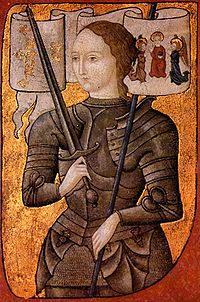
"Then the Maid, surpassing the nature of a woman, took on a great force, and took much pain to save her company from defeat, remaining behind as the leader and as the bravest of the troop. But there fortune permitted for the end of her glory and for the last time that she would ever carry arms. An archer, a rough and very sour man, full of much spite because a woman, who so much had been spoken about, should have defeated so many brave men, as she had done, grabbed the edge of her cloth-of-gold doublet, and threw her from her horse flat to the ground."

Cyrill Demian (1772–1847) made his living as an organ and piano maker, with his two sons Karl and Guido, in Mariahilfer Straße No. 43 in Vienna, Austria. On May 6, 1829, Cyrill and his two sons presented a new instrument to the authorities for patent - the accordion. The patent was officially granted on 23rd May 1829.


William Harvey Carney (February 29, 1840 – December 8, 1908) was an African American soldier during the American Civil War who received the Medal of Honour for his actions during the Battle of Fort Wanger.

Sergeant, Company C, 54th Massachusetts Colored Infantry. Place and date: At Fort Wagner, S.C., July 18, 1863. Entered service at: New Bedford, Mass. Birth: Norfolk, Va. Date of issue: 23rd May 1900.
Citation:
When the colour sergeant was shot down, this soldier grasped the flag, led the way to the parapet, and planted the colours thereon. When the troops fell back he brought off the flag, under a fierce fire in which he was twice severely wounded.


Tuesday, 22 May 2012

IT SHALL BE MADE MANIFEST

On 22nd  May 1844 Mulla Husayn of Boshrueh in Khorasan, a prominent disciple of Siyyid Kázim, entered Shirz following the instruction by his master to search for the promised Qa'im. Soon after he arrived in Shiraz, Mullá Husayn came into contact with the Báb. On the night of 22 May 1844 Mullá Husayn was invited by the Báb to his home; on that night Mullá Husayn told him that he was searching for the possible successor to Siyyid Kázim, the Promised One, and the Báb told Mullá Husayn privately that he was Siyyid Kázim's successor and the bearer of divine knowledge. Through the night of the 22nd  to dawn of the 23rd, Mullá Husayn became the first to accept the Báb's claims as the gateway to Truth and the initiator of a new prophetic cycle; the Báb had replied in a satisfactory way to all of Mullá Husayn's questions and had written in his presence, with extreme rapidity, a long commentary of Surih of Joseph, which has come to be known as the Qayyúmu'l-Asmá and is considered the Báb's first revealed work. Mullá Husayn reported:
He took up His pen, and with incredible rapidity revealed the entire Surih of Mulk, the first chapter of His commentary on the Surih of Joseph. The overpowering effect of the manner in which He wrote was heightened by the gentle intonation of His voice which accompanied His writing. Not for one moment did He interrupt the flow of the verses which streamed from His pen. Not once did He pause till the Surih of Mulk was finished. I sat enraptured by the magic of His voice and the sweeping force of His revelation

After Mullá Husayn accepted the Báb's claim, the Báb ordered him to wait until 17 others had independently recognized the station of the Báb before they could begin teaching others about the new revelation.

Siyyid `Alí Muḥammad Shírází was the founder of Bábism, and one of three central figures of the Bahá'í Faith. He was a merchant from Shiraz, Persia, who at the age of twenty-four (on May 23, 1844) claimed to be the promised Qa'im (or Mahdi). After his declaration he took the title of Báb meaning "Gate". He composed hundreds of letters and books (often termed tablets) in which he stated his messianic claims and defined his teachings, which constituted a new sharí'ah or religious law. His movement eventually acquired tens of thousands of supporters, was opposed by Iran's Shi'a clergy, and was suppressed by the Iranian government, leading to the persecution and killing of thousands of his followers, called Bábís. In 1850, at the age of thirty, the Báb was shot by a firing squad in Tabríz.

“The gateway to Truth” How many prophets have made this claim, to be the gateway to truth. In his book on Heidegger, George Steiner states, inter alia:

The Being of being(s) is the only proper object of ontological thought ... it is to immerse oneself in the full ‘thereness’ of things, for it is only in their unconcealment that Being, though hidden itself, is revealed.  Every inanimate and animate presence, ontologically wondered at and thought ‘through’ ...  becomes a ‘clearing’, a Lichtung in which Being declares itself.  Like the light which plays around objects in the dark of the wood even though we cannot place its source.[…]Heidegger begins to give concealment ontological precedence over unconcealment. It is the mark and nature of significant truth to stay hidden, though radiant in and through this occlusion. Man, moreover, is not the enforcer, the opener of truth ... but the ‘opening for it’, the ‘clearing’ or Lichtung in which it will make its hiddenness manifest.

In short, we are each and every one of us a gateway to the truth. Start with that, no one needs to be revered and no one needs to get shot.

Monday, 21 May 2012

LAW AND CRIMES AGAINST HUMANITY


Some early legal performance writing from Serbia.

Dušan's Code (Serbian: Душанов законик, Dušanov zakonik, known historically as Закон благовјернаго цара Стефана) is a compilation of several legal systems that was enacted by Stephen Uroš  IV Dušan of Serbia in 1349. It was used in the Serbian Empire and the succeeding Serrbian Despotate. It is considered an early constitution, or close to it; an advanced set of laws which regulated all aspects of life.
The Code was promulgated at a state council on 21 May 1349, in Skopje, the capital of the Serbian Empire. The foreword is as follows: "We enact this Law by our Orthodox Synod, by His Holiness the Patriarch Kir Joanikije together with all the Archbishops and Clergy, small and great, and by me, the true-believing Emperor Stephen, and all the Lords, small and great, of this our Empire". In the Charter, which accompanied the Code, it said: "It is my desire to enact certain virtues and truest of laws of the Orthodox faith to be adhered to and observed". Emperor Dušan added a series of articles to it in 1353 or 1354, at a council in Serres.  This second part was half the size and at times cited issues from the first part, referring it to the "first Code".
Some parts of the code:
On the Law
Further commandeth our Imperial Majesty:
Should our Imperial Majesty write a letter
Out of wrath, or out of love
Or out of mercy for any one,
And should such a letter contravene the Code
And be at variance with the law and justice
As set down in the Code,
The judges
Shall not comply therewith
But shall judge
And act withal as justice commandenth.
On Poor Women
Any poor woman unable to litigate
Or defend herself shall choose an attorney
Who shall speak on her behalf.
The poorest hemp-spinstress shall be as free as a priest shall.
On Prisoners
Whoso escapeth from prison to the Imperial Court, be he a serf of the Crown, or of the Church, or of a nobleman, shall by the act itself be set free; should he be bearing any gifts for the man to whom he hath escaped, he shall return them to the man from whom he hath escaped.
Whoso escapeth from the prison at our Imperial Court to the patriarchal court shall be set free; also shall be set free any man who escapeth from the patriarchal prison to the Imperial Court.
Also, should any one give shelter to a man from a foreign land, and that man be a fugitive from his master of from justice holding our imperial letter of clemency, said letter shall not be contested; should he hold no such letter, he shall be returned wherefrom he hath escaped.

A bit strange, but very performative.     
Taubira
Equally strange, given the date, but no doubt performative, was that on the 21st May 2001 the French Taubira Law was enacted.

Christiane Taubira or Christiane Taubira-Delannon  is a French politician, and, from 15 May 2012, the Minister of Justice in the new Ayrault government, under President Hollande. President of her party Walwari, she has served as a deputy at the French National Assembly since 1993, and was re-elected in 1997. In 1994, she became a Member of the European Parliament (MEP), being the fourth on the Energie Rdicale list led by Bernard Tapie. In June 1997, she then joined the Socialist Party (PS), and then-Prime Minister Lionel Jospin (PS) commissioned her for a report on gold search in Guiana.
Christiane Taubira gave her name to the 21st May 2001 law that recognizes the Atlantic Slave Trade and slavery as a crime against humanity.


Sunday, 20 May 2012

BRITISH AND AMERICAN ICONS OR WHAT YOU WILL


Shakespeare's sonnets are a collection of 154 sonnets, dealing with themes such as the passage of time, love, beauty and mortality, first published in a 1609 quarto entitled SHAKE-SPEARES SONNETS.: Never before imprinted.

The publisher, Thomas Thorpe, entered the book in the Stationers’ Register on the 20th May 1609:
Tho. Thorpe. Entred for his copie under the handes of master Wilson and master Lownes Wardenes a booke called Shakespeares sonnettes vjd.
Whether Thorpe used an authorised manuscript from Shakespeare or an unauthorised copy is unknown.

Levi Strauss
Dry goods merchant Levi Strauss was selling blue jeans under the "Levi's" brand to the mining communities of California in the 1850s. One of Strauss's customers was Jacob Davis, a tailor who frequently purchased bolts of cloth from the Levi Strauss & Co. wholesale house. After one of Davis' customers kept buying cloth to reinforce torn pants, he had an idea to use copper rivets to reinforce the points of stress, such as on the pocket corners and at the top of the button fly. Davis did not have the required money to purchase a patent, so he wrote to Strauss suggesting that they both go into business together. After Strauss accepted Davis's offer, the two men received U.S. Patent 139,121, for an "Improvement in Fastening Pocket-Openings," on 20th May 1873.
Rockwell


On the 20th May 1916 the Saturday Evening Post publishes its first cover with a Norman Rockwell painting (Boy with Baby Carriage).


Saturday, 19 May 2012

FAMILY MATTERS


The 19th May brings up various family matters.
On the 19th May 1536, Anne Boleyn, second wife and Queen of Henry VIII of England, was beheaded on trumped up charges of adultery, treason and incest.
Thirty-two years later, on the 19th May 1568, her daughter Queen Elizabeth I of England, ordered the arrest of her own cousin Mary, Queen of Scots, on suspicion of treason.


In keeping with British Peerage, William Byron, 5th Baron Byron also known as "the Wicked Lord" and "the Devil Byron", was the poet George Gordon Byron’s great uncle.  He died on the 19th May 1798. The title passed to his great nephew, George Gordon Byron, then age 10, becoming "Lord Byron". George Gordon eventually dropped the double surname (though after this point his surname was secondary to his peerage); thus, on the 19th May 1798, Byron Todd Frank, 6th Baron Byron, became George Gordon Noel, 6th Baron Byron, FRS, commonly known simply as Lord Byron. He was a British poet and a leading figure in the Romantic Movement. He too, obtained the sobriquet, the Wicked Lord Byron. I guess it ran in the family.

In keeping with writing matters, Anne wrote a last letter to Henry, dated 6th May 1536 a fortnight before her death. It contains both romance and politics. Lord Byron could not have done better.
"Sir,
Your Grace's displeasure, and my imprisonment are things so strange unto me, as what to write, or what to excuse, I am altogether ignorant. Whereas you send unto me (willing me to confess a truth, and so obtain your favour) by such an one, whom you know to be my ancient professed enemy. I no sooner received this message by him, than I rightly conceived your meaning; and if, as you say, confessing a truth indeed may procure my safety, I shall with all willingness and duty perform your demand.
But let not your Grace ever imagine, that your poor wife will ever be brought to acknowledge a fault, where not so much as a thought thereof preceded. And to speak a truth, never prince had wife more loyal in all duty, and in all true affection, than you have ever found in Anne Boleyn: with which name and place I could willingly have contented myself, if God and your Grace's pleasure had been so pleased. Neither did I at any time so far forget myself in my exaltation or received Queenship, but that I always looked for such an alteration as I now find; for the ground of my preferment being on no surer foundation than your Grace's fancy, the least alteration I knew was fit and sufficient to draw that fancy to some other object. You have chosen me, from a low estate, to be your Queen and companion, far beyond my desert or desire. If then you found me worthy of such honour, good your Grace let not any light fancy, or bad council of mine enemies, withdraw your princely favour from me; neither let that stain, that unworthy stain, of a disloyal heart toward your good grace, ever cast so foul a blot on your most dutiful wife, and the infant-princess your daughter. Try me, good king, but let me have a lawful trial, and let not my sworn enemies sit as my accusers and judges; yea let me receive an open trial, for my truth shall fear no open flame; then shall you see either my innocence cleared, your suspicion and conscience satisfied, the ignominy and slander of the world stopped, or my guilt openly declared. So that whatsoever God or you may determine of me, your grace may be freed of an open censure, and mine offense being so lawfully proved, your grace is at liberty, both before God and man, not only to execute worthy punishment on me as an unlawful wife, but to follow your affection, already settled on that party, for whose sake I am now as I am, whose name I could some good while since have pointed unto, your Grace being not ignorant of my suspicion therein. But if you have already determined of me, and that not only my death, but an infamous slander must bring you the enjoying of your desired happiness; then I desire of God, that he will pardon your great sin therein, and likewise mine enemies, the instruments thereof, and that he will not call you to a strict account of your unprincely and cruel usage of me, at his general judgment-seat, where both you and myself must shortly appear, and in whose judgment I doubt not (whatsoever the world may think of me) mine innocence shall be openly known, and sufficiently cleared. My last and only request shall be, that myself may only bear the burden of your Grace's displeasure, and that it may not touch the innocent souls of those poor gentlemen, who (as I understand) are likewise in strait imprisonment for my sake. If ever I found favour in your sight, if ever the name of Anne Boleyn hath been pleasing in your ears, then let me obtain this request, and I will so leave to trouble your Grace any further, with mine earnest prayers to the Trinity to have your Grace in his good keeping, and to direct you in all your actions. From my doleful prison in the Tower, this sixth of May;
Your most loyal and ever faithful wife,
Anne Boleyn"


Friday, 18 May 2012

WRITING SPIES, TREATIES AND RAMPAGE

Some stuff for the 18th May:
The playwright Thomas Kyd was arrested on the 12th May 1593 for heresy and grassed up Christopher Marlowe. Both writers may have been involved with Queen Elizabeth’s spymaster Sir Francis Walsingham. There is quite a performance in the short lives and writings of these two characters.
Marlowe (maybe)
In early May 1593 several bills were posted about London threatening Protestant refugees from France and the Netherlands who had settled in the city. One of these, the "Dutch church libel", written in blank verse, contained allusions to several of Marlowe's plays and was signed, "Tamburlaine". On the 11th  May the Privy Council ordered the arrest of those responsible for the libels. The next day, Marlowe's colleague Thomas Kyd was arrested. Kyd's lodgings were searched and a fragment of a heretical tract was found. Kyd asserted that it had belonged to Marlowe, with whom he had been writing "in one chamber" some two years earlier. It is believed that Kyd was tortured brutally to obtain this information. At that time they had both been working for an aristocratic patron, probably Ferdinando Stanley, Lord Strange. A warrant for Marlowe's arrest was issued on the 18th May, when the Privy Council apparently knew that he might be found staying with Thomas Walsingham, whose father was a first cousin of the late Sir Francis Walsingham, Elizabeth's principal secretary in the 1580’s and a man more deeply involved in state espionage than any other member of the Privy Council. Marlowe duly presented himself on the 20th May but, there apparently being no Privy Council meeting on that
day, was instructed to "give his daily attendance on their Lordships, until he shall be licensed to the contrary". On Wednesday the 30th May, Marlowe was killed. He was 29 years old. Thomas Kyd died 15 months later aged 35, a broken man.
The Treaty of Amiens was entered into to end hostilities between the French Republic and the United Kingdom during the French Revolutionary Wars. It was signed in the city of Amiens on 25 March 1802 (Germinal 4, year X in the French Revolutionary Calendar), by Joseph Bonaparte and the Marquess Cornwallis as a "Definitive Treaty of Peace". It was, of course the usual carve up of the world. England withdrew, not for the first time, from Egypt and obtained possession of Trinidad, Tobago and Ceylon.
Cornwallis
Joseph Bonaparte
(Napoleon's older brother)


The treaty, beyond confirming "peace, friendship, and good understanding", called for:
▪   The restoration of prisoners and hostages.
▪   The United Kingdom to return the Cape Colon to the Batavian Republic.
▪   The UK to return most of its captured Dutch West Indian Islands islands to the Batavian Republic.
▪   The UK to withdraw its forces from Egypt.
▪   The ceding to the UK of Trinidad, Tobago and Ceylon.
▪   France to withdraw its forces from the Papal States.
▪   The borders of French Guiana to be fixed. 
▪  Malta, Gozo and Comino to be restored to the Hospitallers and to be declared neutral, although the islands remained under the British Empire.
▪  The island of Minorca be returned to Spain.
▪  The House of Orange-Nassau was to be compensated for its losses in the Netherlands.
Two days after signing the treaty, all four parties signed an addendum specifically acknowledging that the failure to use the languages of all of the signatory powers (the treaty was only published in English and French) was not prejudicial and should not be viewed as setting a precedent. It also stated that the omission of any individual's titles was unintentional and also not intended to be prejudicial. The Dutch and French representatives also signed a separate convention clarifying that the Batavian Republic was not to be financially responsible for the compensation paid to the House of Orange-Nassau.
All of which brings us to the 18th May 1803 when the United Kingdom revoked the Treaty of Amiens and declared war on France. This ‘definitive treaty of peace’ lasted just over one year,

Shawn Timothy Nelson was a U.S. Army veteran and unemployed plumber who stole an M60 Patton tank from a United States National Guard Armory in San Diego, California and went on a rampage on the 18th May 1995, destroying cars, fire hydrants, and an RV before being shot and killed by police

Thursday, 17 May 2012

PLOTS POLITICS & PSYCHIATRY


The 17th May brings out little bit of political history.

Chief architect of plots
Thomas Cromwell
On looking into events of the month of May, it appears to have been a very bad fortnight for the Boleyn family. The various plots were hatched during the last weeks of April 1536 and brought to conclusions with extreme prejudice in May. On the 17th May 1536, George Boleyn, Anne’s brother, and four others accused of treason were executed.


There is also something in this date for the Liberal Democrats to note. It has been 97 years since Britain had an all-Liberal government. Whatever pretentions the Liberal Democrats may have in being influential in government affairs have been overshadowed by this history. They have lost any sense of purpose after nearly a century of struggle to gain a seat in the cabinet. Having at last sat down, they have no idea of what they are there for. They have simply forgot why they wanted the seat in the first place. When serious decisions have to be made, they back off and leave it all to the conservatives. That is what split the party in 1915 and nothing seems to have changed. Perhaps I exaggerate but the history is there.
Asquith
When World War I broke out in August 1914, the war struck at the heart of everything British Liberals believed in. The party became divided over the distinctly illiberal policies that were introduced under her auspices, including conscription and the Defence of the Realm Act. Several Cabinet ministers resigned, and Asquith, the master of domestic politics, proved a poor war leader. Lloyd George and Churchill, however, were zealous supporters of the war, and gradually forced the old pacifist Liberals out. The poor British performance in the early months of the war forced Asquith to invite the Conservatives into a coalition (on 17th May 1915). This marked the end of the last all-Liberal government. This coalition fell apart at the end of 1916, when the Conservatives withdrew their support from Asquith and gave it to Lloyd George instead, who became Prime Minister at the head of a coalition government largely made up of Conservatives. Asquith and his followers moved to the opposition benches in Parliament and the Liberal Party was split once again.


So far as gender politics is concerned, on the 17th May 1990 The General Assembly of the World Health Organization (WHO) finally eliminated homosexuality from the list of psychiatric diseases. On the 17th May 2004, Massachusetts became the first U.S. State to legalize same-sex marriage.